

In the Old Testament, Moses is asked a simple question: “What is that in your hand?” His answer is equally simple: “a staff”. An ordinary tool, familiar and easy to overlook.
Yet, when placed in the service of a greater purpose, that ordinary staff became an instrument of extraordinary change. It was used to demonstrate authority, guide people through uncertainty, and unlock possibilities that once seemed impossible.
The lesson extends far beyond the biblical story. What we hold matters, but what we are empowered to do with it matters even more.
At dfcu Foundation, this principle shapes how we view digital technology. A computer, on its own, is equipment; a screen, a keyboard and processing power. But in the hands of a learner, entrepreneur, farmer, innovator or public servant, it becomes a tool for transformation. It can open a classroom, connect a business to markets, strengthen decision-making, and turn ideas into opportunity.
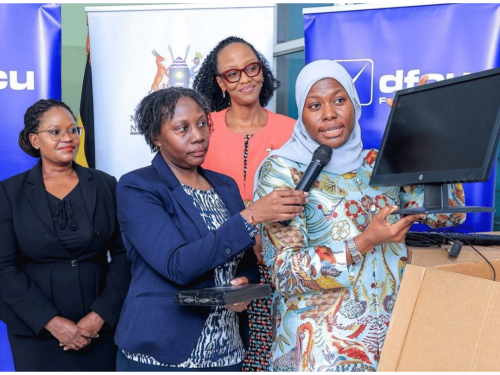
This thinking informed our recent partnership with dfcu Bank and the Ministry of ICT and National Guidance, through which 100 computers were donated to support innovation hubs and digital learning centres across Uganda. The true significance of this initiative lies not in the devices themselves, but in what people will be able to achieve with them.

Helena Mayanja, Dr. Aminah Zawedde and Mabel Ndawula during the handover of the computers at the Ministry of ICT & National Guidance Innovation Hub in Nakawa.
Digital inclusion cannot be measured by the number of devices distributed alone. A computer sitting idle does not close the digital divide. Transformation happens when access is combined with practical skills, relevant content, mentorship and opportunities to apply knowledge in meaningful ways.
That is why digital investments should ultimately be judged by outcomes: improved employability, stronger and more efficient businesses, better decisions and locally relevant innovations.
“Technology creates its strongest impact when it is connected to a real need and gives people the confidence to act.”
This philosophy has guided dfcu Foundation’s digital-learning journey for years. Through our Remote Training Kits, we have delivered more than 241 virtual training sessions to over 5,000 participants, extending business and agricultural advisory services to communities, including hard-to-reach areas. SOMA, our free self-paced e-learning platform, has logged 20,333 learners since inception, providing practical content in financial literacy, entrepreneurship, governance, digital skills and climate-smart agriculture, among others. Through Digital Learning Hubs in Kampala, Kyotera and Buikwe, additional learners and entrepreneurs have gained access to skills development opportunities.
Similarly, BeanBook, a price risk management platform, demonstrates how technology can solve sector-specific challenges. Developed for coffee SMEs and cooperatives, it combines market intelligence, transaction analysis and price-risk management tools to help users respond to price volatility, make better trading decisions and strengthen participation in local and export markets.
Across these initiatives, one principle remains constant: technology creates impact when it is connected to a real need and enables people to act with greater confidence and capability.
This matters because Uganda’s economic ambitions increasingly depend on digital capability. Whether in agriculture, tourism, industry, innovation or services, productivity and competitiveness will increasingly be shaped by how effectively people use technology to solve problems and create value.
But inclusion must remain central to this agenda. If young people, women, rural communities and smaller enterprises lack access to digital tools and skills, Uganda risks leaving a significant share of its talent and potential untapped. The challenge is not simply to bring more people online, but to enable more people to participate meaningfully in the digital economy.
Achieving this requires partnership. Government provides policy direction and public infrastructure. The private sector contributes investment, technology and market expertise. Educators build skills, while development partners and communities help ensure solutions remain relevant and scalable.
At dfcu Foundation, we believe our role extends beyond financing. Sustainable enterprise growth requires knowledge, skills, market access and the confidence to embrace new opportunities. Since inception, the Foundation has reached more than 78,000 individuals, supported over 2,900 enterprises and facilitated access to more than USD 39.5 million in financing. These outcomes reinforce a simple belief: transformation happens when tools are supported by knowledge, opportunity and purpose.
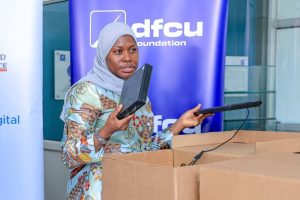
Dr. Aminah Zawedde, Permanent Secretary at the Ministry of ICT and National Guidance, demonstrates one of the 100 desktop computers donated by dfcu Foundation in partnership with dfcu Bank.
Ultimately, the success of the 100-computer donation will not be measured by the donation ceremony. It will be seen in the young person who gains a marketable skill, the entrepreneur who grows a business, the farmer who makes a better commercial decision, and the innovator who develops solutions to local challenges.
Uganda already possesses many of the ingredients needed for progress: a young and enterprising population, innovative communities, supportive institutions and a growing digital ecosystem. The question is whether we can bring these assets together around a common purpose.
A computer is equipment. But when placed in capable hands, connected to knowledge and directed towards a real need, it becomes far more than a device. It becomes a gateway to opportunity.
Just like the staff in Moses’ hands, its transformational power is revealed not by what it is, but by what people are enabled to do with it.
Source: CEO East Africa Magazine – Just Like Moses’ Staff, A Computer Is Equipment That Becomes A Tool for Transformation