

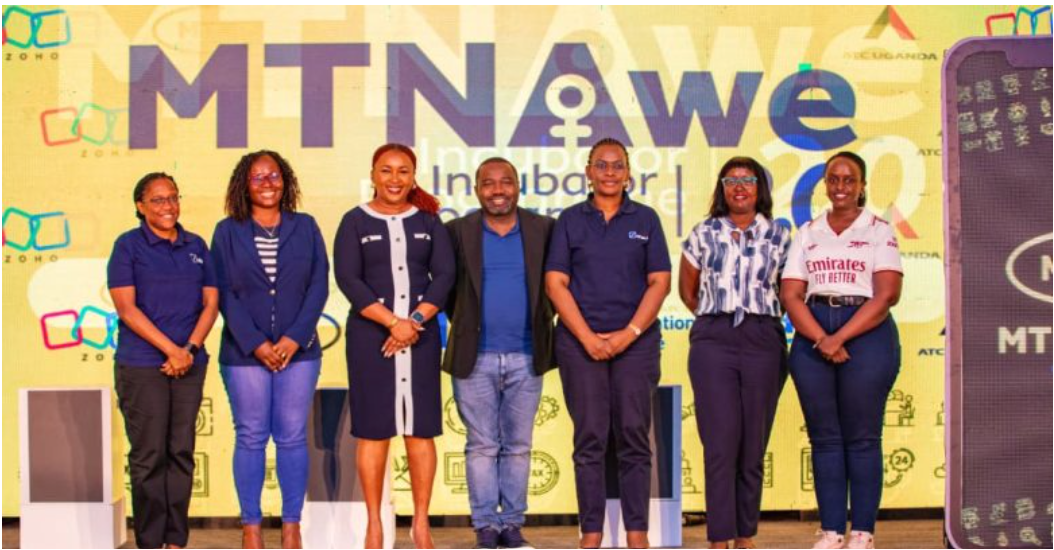
dfcu Bank and MTN Uganda on Thursday launched the second phase of their Advancing Women Entrepreneurs (AWE) programme after unlocking 62 billion Ugandan shillings ($16.8 million) in contracts for women-led businesses under the initiative’s first phase. The AWE 2.0 programme will focus on expanding financing, training and procurement opportunities for women-owned enterprises, particularly in Uganda’s technology and infrastructure supply chains.
Margaret Karume, chief credit officer, dfcu bank said the first phase of the programme demonstrated strong uptake but also highlighted the persistent challenge of limited access to finance, markets and business networks.
“What many of these women lacked was not ambition, because they had the ambition, but access,” Karume said. “Access to markets, access to structured business knowledge, to networks, access to finance, and also access to confidence-building ecosystems that help businesses move from survival to sustainable growth.”
She said dfcu had set aside 30 billion shillings for financing over three years and had already disbursed 2 billion shillings in loans to 19 businesses under contract financing following the March 2024 launch of the first cohort. Karume added that the bank had opened 90 accounts for participants, including 71 business accounts, and helped mobilise about 5 billion shillings in deposits. She said the next phase would focus on helping women entrepreneurs transition from informal activity into structured, scalable enterprises capable of attracting investment and winning larger contracts.
“Many entrepreneurs begin with passion and the hassle, but as they grow, structure becomes essential for a business,” Karume said. “You need proper financial records, sound systems, digital tools, procurement readiness, governance, compliance with the laws and regulations of the land, and confidence to sit across the table from corporate customers and investors and say, my business is ready.”
Sylvia Mulinge, CEO MTN Uganda said the programme was designed to address a supplier inclusion gap in sectors where the telecoms firm spends heavily, including fibre rollout, network infrastructure and IT services. She said MTN Uganda had increased the share of women-led suppliers in its ecosystem from 0.3% to 15% since the programme began in 2023, alongside 62 billion shillings in contracts awarded to women-owned businesses.
“When I see all women who have stood here, I’m not just seeing women, I’m seeing businesses, I’m seeing businesses that are employing people, I’m seeing lives that are being raised,” Mulinge said.
She said more than 1.6 billion shillings in financing had also been extended to women-led enterprises. Mulinge cautioned, however, that businesses must still compete on equal terms in pricing, technical capacity and delivery.
“We can open the way for you,” she said. “But if you don’t come and compete in terms of price, in terms of technical capability, as all the rest of the other male-owned businesses, it should be difficult for us to keep.”
Mabel Ndawula, executive director dfcu Foundation said the programme’s financial management training would focus on building disciplined, sustainable business practices, including proper record keeping and separation of personal and business finances.
“We need to get you to a point where there’s absolute distinction between business and family or owner cash,” Ndawula said. “Without this base, you cannot really become that bridge we’re looking at.”
She added that many small businesses still relied on manual bookkeeping systems and needed to adopt basic digital tools to improve efficiency and resilience.
“You cannot build a bridge with analog methodologies,” she said. “Even if it’s the most basic of automations, how can you do this on spreadsheets? It’s better than manual writing with a pen.”
Source: ChimpReports – dfcu, MTN Launch AWE 2.0 with Focus on Women-Led Tech Suppliers