

Musinguzi Marion – Apple Farmer, Kanungu
“I got to know SOMA from my mother who sent me a link via Facebook. All the processes of registering and learning were seamless and I think it will change the lives of my village farmers since most of them are still illiterate.”
Robert Mugabe – Kigarama People’s Cooperative Saving & Credit Society
“I first got Ugx. 10million then Ugx. 25million. I pay monthly on a 2.7 % interest in reducing balance. I keep my records and keenly follow my loan repayment and I also know how much I have put in my farm just like I was taught by ADC, so it is easier for me to repay the loan.
I have never defaulted my loan, I pay promptly. I recently applied for Ugx. 30million to develop a new plantation and a tree plantation so that the trees can help me to deal with hailstorm and the like. When the banana is at its peak, I get 6 million per month, for example this month I harvested thrice because it is the season.”

By Anja De Feijter
How is the new mobile App for Dairy farmers relevant to farm technologies and management?
Farm management draws on agricultural economics for information on prices, markets, agricultural policy, and economic institutions such as leasing and credit. This means the dairy sector needs to include information support systems to Dairy management information system supports four of five propositions: reduced product shortcoming, optimal product mix, quality, and efficiencies for the farmers.
Agribusiness development Centre(ADC) together with our partners developed a solution for the dairy farmers and rolled to Bugerere dairy cooperative with over 300 members. Edward Mukimbiri, a farmer in Bugerere Dairy cooperative, delivers 20 liters per day for two times 6:00am and to his cooperative where he is a manager, when he delivers his milk.
eMata is an application tailored for dairy farmers to allow them to use the power of loans to invest in the productivity of their produce. It allows transparent recording and ensures daily milk deliveries are registered whereby the farmer automatically gets instant information about the quantity and price of the milk delivery.
eMata allows dairy cooperatives to effectively manage their administration, including their membership, farmer profiles, payment methods, deliveries and deductions. It makes calculation of farmer payments simple and fast, and supports multiple modes of payment such as cash, mobile money and bank.
When financially sustainable technologies and good management practices are used in unison, new levels of farm productivity become obtainable. The long-term goal of the app is to use the data to provide financial services to cooperatives and farmers, such as credits in terms of goods and services, loans and payments.
eMata is free to use but distributed through field partners and rolled out on cooperative basis. If you want to use eMata for your cooperative, please contact Laboremus Uganda Ltd. “Through smart use of both technology and field training, we believe that this partnership will build a foundation on which cooperatives and farmers can grow stronger, more efficient and prosperous.
The standards of living of rural farmers.
According to statistics from Uganda Dairy Development Authority, out of Uganda’s annual milk production of 2.5 billion litres, 80 per cent is sold while 20 per cent is consumed by the producing households. Middlemen take the lion’s share of proceeds from milk and this is so because farmers face challenges such as difficulty in accessing the market, production on a small scale by individual farmers and failure to access financial services to improve on production, among others.

Interviewed by Basemera Priscilla.
Alexander Ruhweza, a franchise support associate at Jibu Water with a specialty in agribusiness shares with us his journey in the agricultural sector.
Before you ventured into Agriculture, what were you doing?
Agriculture has always been my side business which I ventured in during my university days. I used to do part time work on a farm while in Australia. On my return to Uganda, desire to practice agriculture that can help me has never withered.
What type of Agriculture do you carry out?
At the moment, I practice animal husbandry, specifically cows and goats. I am also doing maize, soybean and passion fruit on a large scale in Fort Portal.
As a large-scale farmer, do you operate the passion fruit plantation as an individual or as a cooperative?
Actually, the passion fruit growing done on large scale falls under a project called KadAfrica and we specifically work with girls only.
Tell us more about this project. Why girls in particular?
Great question, firstly the girl child is more vulnerable, marginalised and have a number of problems she faces. Because of that, we designed this project where we recruit 20 -30 girls, look for a nearby church with free land and put that land to use. Churches have a lot of land available, so we sign a contract with them to use about 2 acres of their land for a minimum of three (3) years. This land is divided into sub plots and we provide seedlings and chemical inputs. After the crop is grown, we buy the harvest from them. With this, the girls come out empowered with both farming and business skills. This has greatly improved the standard of living for most of them and their family members.
What is the criteria for the girls you choose to work with?
Our focus is on the girl within the age brackets of 13 -24 years because statistically this group is vulnerable to evils such as early pregnancy, defilement, early marriages and STDs. Contextually, we felt it right to assist this fragile group hence the choice of criteria.
When did you start this project?
The project has been in existence for 7 years. I can proudly say that it has grown exponentially to about 70 acres of passion. In addition, we are slowly moving into soybean growing known as the Alexander Macrea project which will have a forward integration so as to produce processed soya products.
How many girls are you working with at the moment on KadAfrica?
Around 2,000 girls.
Is this project specific to areas within Fort Portal only and are there plans on expanding?
We are currently present in Kabarole and Kyenjojo but growing slowly as we are limited by funds. If we are to expand, we will do so within surrounding areas like Kyegegwa, Kasese, Bundibugyo and Ntoroko.
Matovu Richard – Bufumbo Organic Farmers Association
“We exported over 40 metric tons in the first year and then we exported 63 metric tons of coffee. With the Price Risk Management training and the financial literacy trainings has taught us how to negotiate a contract, what the different incoterms mean. Now that I know my stand in the market, I can well express myself with the buyer and ask for better prices. The training is also helping us on how to arrange our data, with the spread sheets we can extract data easily.”

By Communications Staff
Agribusiness Development Centre (ADC) supports farmers in 4 different regions of the country by training them in good governance, financial literacy, marketing and a special training for coffee and cocoa farmers in price risk management.
During the pandemic, ADC carried out a research through its experienced group of business advisors in the Eastern, Western, Central and Northern regions to find out how the pandemic had affected their businesses and lives so that solutions are found to the challenges.
Below are some of the challenges and some of the solutions ADC adopted:
All the above challenges need a combined effort from ADC and its partners to support the FBOs to get back on their feet.
ADC has created an e learning tool to give farmers trainings virtually to continue building their capacity so that they can become self-sufficient. An SMS system was also adopted during the lockdown, daily messages that enlightened farmers on measures of how to keep safe from COVID19 and the daily tips on financial literacy especially during a crisis.
ADC also created a WhatsApp group where most farmers who have smart phones can interact and share experiences but most importantly it acts as a market connection for farmers who advertise on the platform but also referrals from the Business Advisors and processors on the group.
Finally, one of ADC’s effort is towards working with Partners to create packages and develop sustainable modules to support farmers.
Great appreciation goes to those that have supported ADC to be able to continue supporting Farmer Based Organizations (FBOs).
Mary Nalukwata – Kibinge Coffee Farmers’ Cooperative Society
“Now that we know our stand in the coffee market and the training helps us small producers compete with the other big players and international producers in the market since these people are well conversant with the market trends and dynamics yet for us, we are not. So, the ADC training is empowering us.”

Interviewed by Basemera Priscilla.
Maximization of online opportunities with SOMA Digital Campaign.
With the existence of the global pandemic COVID-19 and its impact on business activities, Agribusiness Development Centre (ADC) utilized the internet as a link to farmers, farmer-based organizations (FBOs) and the general public who have been spending most of their time at home and on their smartphones.
Online channels have been an ideal way of raising awareness of activities that businesses are indulging in during the ongoing pandemic. ADC through a digital campaign labeled “Register to Win” launched SOMA, an e-learning platform specific to agribusiness on its social media channels Facebook, Twitter and Instagram. SOMA can be accessed on www.soma.adc.ug. The main aim of this campaign was to encourage people to sign-up for lessons on the SOMA platform. The 1st 10 people to register each week were hosted at the ADC offices in Kampala on Plot 1 Mackinnon Road for an interaction with the ADC Team and in appreciation of their efforts parted with a gift hamper.
This campaign ran for 4 weeks bringing in a total of 40 winners.
From the 40 winners, only 14 were within Kampala during the campaign and shared their experience with SOMA upon their visit to the ADC offices. These 14 winners comprised of students, farmers, teachers and businessmen to mention but a few.
At this gathering, the ADC Team was represented by the Ag. General Manager, Emmanuel Obuko; Head of Communication and Marketing, Katia Mugenzi and Software Engineer, William Ssenyondo who developed the SOMA platform.
Watch the video below to catch a glimpse of what some of the winners had to say about SOMA.
Francis Ayo – Adolo Amido Coperative
“I used to take about 8 bottles of beer, but now, I only take water to save the money for my business. It used to cost me 3000 shillings times 8 bottles in 30 days, you can imagine that’s a lot of money which can cater for other things. Before we suffered in the hands of banks, we applied for loans, but we were never given.
After the ADC training, we sat down as a cooperative and decided that everyone contributes a shilling from the produce, we save it at cooperative level. As I talk now, we have saved 5 million shillings in our account and we have a good relationship with the DFCU bank now. They are so willing to give us money because we are more organized, we don’t delay, and they don’t delay serving us as a cooperative”
By Mugenzi Katia
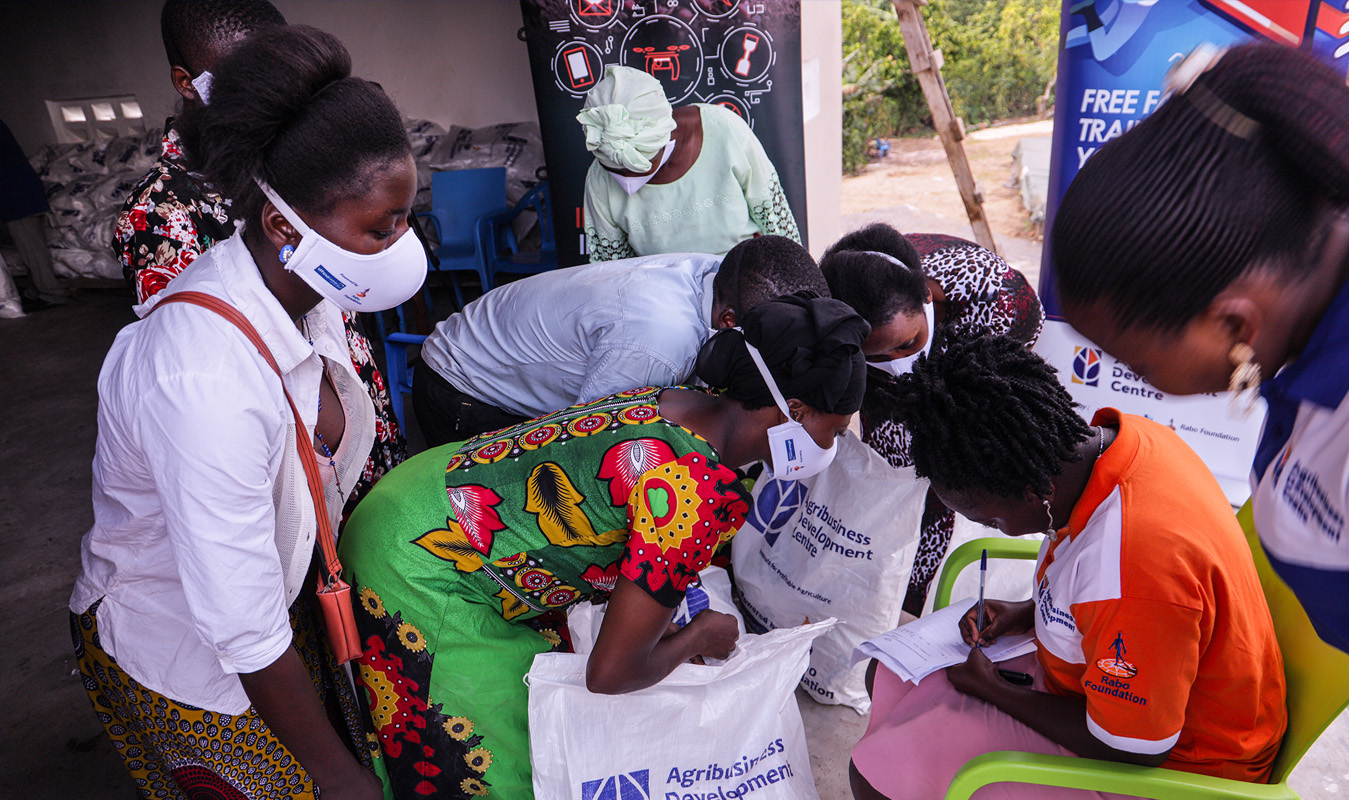
Rabo Foundation, DFCU Bank through its partner ADC extended relief to farmers affected by both COVID19 and flooding.
In light of the COVID 19 pandemic and natural disasters; landslides that have adversely affected some of the members of supported FBOs, the Agribusiness Development Centre (ADC) together with its investment partners Rabo Foundation and DFCU bank extended food assistance, sanitation and personal protective equipment to over 350 small holder farming households which were affected by the recent landslides in Bundibugyo, and COVID 19 affected vulnerable households in Kamuli and Masaka districts.
The 350 affected small holder farmers are among the over 8000 trained members of Farmer Based Organizations currently in ADCs Agribusiness Training program. Each household received a package consisting of 20Kgs of Maize Flour, 10Kgs of Beans, 5kgs of Cassava Flour, 5kgs of Rice, 1 liter of Cooking Oil, 3 Packets of Salt and 2 Bars of iodized salt and a mask.